
A nerdy & longwinding post about faster skis and developing stability 🙂
Original post in Swedish: 2021-07-15 by Örjan Skatt / Örjans Skidskola
Translation & Update: 2024-05-28 By Örjan
Strive for improvment as a surfskier: To Be Continued
Faster ski – or not a faster ski?
Now that the water is getting warm here in the Nordics, holidays ahead – it´s the perfect time to challenge yourself with more difficult paddling – and maybe swim a little 🙂
There are several ways to challenge your paddling. Yeah, stronger winds….. Tougher Intervalls. Longer downwinds. Faster ski – especially if the summer ahead only offers light wind or dead calm mirror-ocean…. Challenging yourself may be a good way to keep and enhance the joy in paddling – strive for better paddle technique.
It’s surprisingly often people who are not considered particularly athletic or generally outstanding in sports, who manage the faster ski early on. Some buy a faster ski right away, others very late or not at all. A ski may be tippy for one person, but stable as a couch for another.
Yes, we are different ❤️
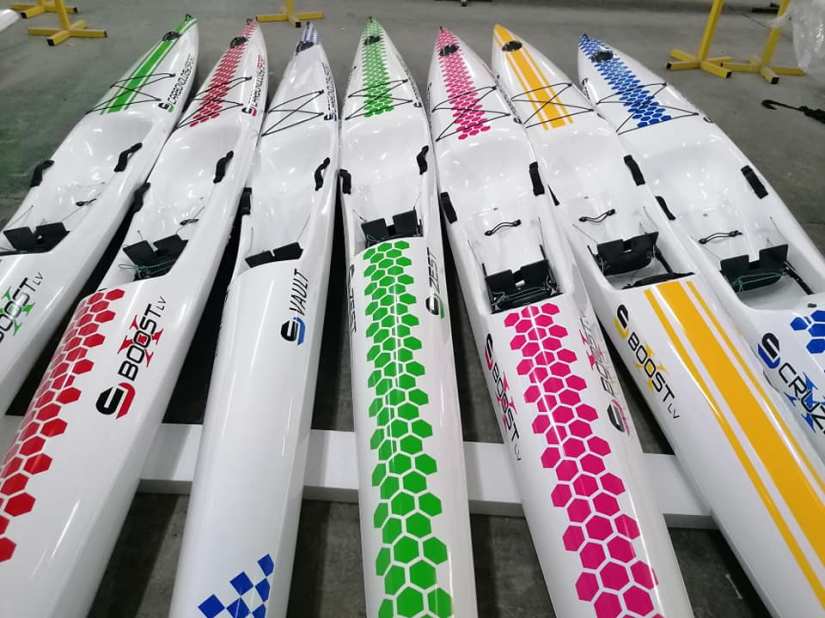
Elit Skis. Yes, there is a time for some – when stability is no longer an issue – but few surfskiers ever get there. Let’s call them elite. They paddle elite skis. This post is not for them – it’s most of all for us paddling for health and joy (or just to beat a bunch of friends in the next race).
Me. Yes, I often paddle elite ski, the Carbonology Flash, but I’m far from elite-level in any sense. Paddled for 10 yrs, since my 40-yrs-crisis, for health, socially, the joy of it, and of course to beat Aterra-Leif in the next race. So, in cross-winds approx 10m/s and above, I generally prefer my beloved Zest. In ice-cold winterstorms, I even use Boost – if I’ve only been skiing (on snow) for months.
Objective & disclaimer: I’m going to delve into a long-winded post about stability and speed in surfskis, and how to develop – from my point of view. If you’re not a surfski-nerd, you may fall asleep…..
As usual, I do not claim to convey absolute truth or complete scientific background. Expect no factual news, but I hope someone can relate to their own reality and maybe benefit in some way from a somewhat new or different perspective. Tips and tricks are primarily aimed for intermediates, and in some parts masters.
Stability, speed and a faster ski
But why does “everyone” want a faster ski? – Well, after all, surfski is (also) a competitive sport, and the definition of a surfski race may be a matter of definition. Two surfskiers within sight may be a race. Some want to be fast, some desperately need to win, some just want to keep up with the pack in the downwinds. Some just want to cruise around, occasionally get some exercise or catch a wave or two.
Some laugh about “the fast ski thing” and refer to the fact that it is less than 1 km/h difference between the fastest elite ski and a plastic entry-level ski when tested on flatwater 9-10 km/h and maybe something like 200 W paddeleffect (ref to Dietz test of Nelo skis, www.dietz.se, thanx Christan for sharing great insights in your post a couple of years ago). Yes, it’s exactly like that – Surprisingly small differences between skis in absolute numbers (as long as the speed is in the test-range or lower).
One of the widest, heavy models was among the first to finish at the Surfski Open Race in Båstad when the wind was great and strong (18-22 m/s) a bounch of years ago. Also, My friend Eric won big time in his wide (but light) ski at the “wednesday-series” – tricky winds from the side. Speed is in the paddler – paddle-technique & fitness. No, this post in not for you Eric – you will probably keep beating me in your fat ski – while I may paddle that ”fast” ski. This post is neither for cruisers, not chasing long runs, not chasing faster skis, or fellow surfski-friends all the way to the beach. This post is simply for people obsessed in chasing……
Speed – let’s count it down.
– 10 km/h gives a time of exactly 60 minutes for 10 km.
– 11 km/h gives a time of approximately 54.30.
So – in a 20 km flat surfski race, only the speed of the boat may explain 10-11 minutes (given that the paddler is stable enough in the elite ski). That’s big numbers in the results. And the objective explanation why so many look for a faster ski.
Even the sense of speed and acceleration is palpable, and may single-handedly explain the widespread faster-ski-disease.
Many beginners or at least intermediates can paddle an elite ski on smooth water. Or at least sit upright, and paddle forward. This leads us to the subject:
Waves = Something Else Than Flat Water
Stability eats speed……
Let’s say it again: The more stable boat is usually faster and more fun in the waves, but also in the flats.
Naturally, people get different problems with stability in waves, because the waves interfere the ski in all directions, and the paddler needs to adapt to, and adjust directional forces in all directions.
Actually, surfskis are more tippy in flat water than in waves due to the construction. The ski gets more stable in waves, as there is more volume at the sides of the hull, mainly in the rear (swedeshape) and above the waterline, in order to get more secondary stability. This secondary stability, stabilise the ski in waves, as you sit upright, while the waves are not horizontal, and therefore strive up the sides of the hull, adding stability to the ski. This effect is at least to a minimum valid for all surfskis (maybe not all K1s), but more in skis designed to offer more secondary stability, and this effect may actually differ a lot. Also the rocker may stabilise the ski, but almost only in pure surf. So, lack of stability in flat water may sometimes be (almost) an equally disturbing problem for the same paddler, in the same boat.
Yes, it’s when the waves builds up, that everything is put to test. Many people test skis on flat water and sense “enough” stability, but when the waves come, it’s often impossible for them to paddle in a sensible way. This is a significantly more common problem for surfski-models designed to offer great top-stability, to the price of lower or sometimes almost no secondary stability.
People with different backgrounds adapt to waves differently.
Surfski beginners: One of my local friends has paddeled semi-racing K1’s and seakayaks since child, a ”lifetime-paddler”, but rather new to surfski. He now paddles elite skis and rather fast K1s, quite unimpeded at the lake, flat water, but he needs the most stable ski (CS Cruze) already in winds of 5-6 m/s at sea. Yes, he even sits upright and paddle also in really rough seas. The most stable ski is simply best, faster and more fun at sea. He also get back to those wider skis and K1’s when doing technique-drills flatwater.
Elite: My general experience in Nordic conditions is that only elite people gain some extra speed in elitskis, when in technical conditions above 10 m/s. Even some of the top elit-people often appears to gain less by using elite-skis in those technichal conditons, than in more controllable wavesystems below or around 10 m/s.
Experienced K1 elite people in Sweden with astonishingly high stability in the fastest and crazy-tippy K1s often start surfski in a faster intermediate ski, such as Vault/Zest or similar – in order to fully focus on the waves. Some fast/elit K1-people are surprisingly unaccustomed to almost all waves, while others ride their K1 in meter-high crosswaves without any visible problems – impressive. The adaptation to waves and surfskis is often a quick process for an elite K1 paddler. With such background, they’re quickly in an elite ski. A friend, elitepaddler, explained that it was only after a couple of downwinds in a heavy club V8, that he really understood the waves, the wave-system and the great variety of possible ways to link waves. As he explained – the V8-downwind, and the following elite-ski-dw, an hour later, was the defining moment for this elite K1-junior to become elite U23-surfskier (in record-time).
”The Intermediate, faster-ski-anxiety Syndrome”: Most of us are more like my local friend in the Cruze, or at least somewhere in between my two friends. Most of us are dwelling about the somewhat faster intermediate ski or the little bit more stable intermediate/beginner ski – now or next year. Maybe a little lighter… This post is about this strive, community, dialog, anxiety, joy.
Actually, people tend to be more psychololocically healthy when in some degree of continious strive. The structure of ”climbing the ladder of surfski models”, continiously getting faster and more stable in faster and faster skis – is a rather structured improvement-scale, and it also involves some healthy physical activity and development. The scale is finetuned inside our mind, the paddeling-level we honestly know about our selves (or at least some of us). Its also an external scale. By showing up with a ski may be a sign to other people roughly my level of paddling-skills. Or at least my own idea of my skills 🙂
Well, this tendency to strive, may be a key to the everlasting ”faster ski anxiety syndrome”. So – Its really just our way to keep some degree of mental health. The faster ski synddrome – is thus a significant health factor, as well. The ”Faster Surfski Healt Factor Index” (FSHFI). Lets establish this key-figure in global WHO-statistics 🙂
Speed, waves and the faster ski
A single missed paddlestroke in the faster ski means you’ve lost more than you can win for quite a long distance. Stability eats speed……
As long as you surf a wave, (at the speed of the wave,) you paddle exactly the same speed with the widest and the narrowest skin. When your attention in the faster ski is directed to paddling technique and stability, instead of the waves, you will miss waves and paddle pressure – and you are immediately slower. Stability eats speed……
The advantage of a faster ski in waves…
… is that it links better forward. You glide a little faster to catch and get over the wave in front, then to the next, further forward in the wave-system, usually at speeds of approx 11-25 km/h depending on conditions. Thigher speed – the a greater speed-advantage for the faster ski. It feels like stable skis needs exponentially more paddle-power to maintain the high speed, built up by surfing a wave. You need to start paddle earlier and harder to link yourself onto the next wave ahead, and therefore a ”cross-wave” to the side may more often be the best choice in the stable boat. The faster ski may link 3 or 4 waves forward i, while the beginner ski only links one or two in the same run, often with much more paddling-effort. The difference in a light wind race may be huge for those who master the faster boat. For example, when I paddled the Boost in breeze-waves of the Kungsbackafjord (“gullesurf” = “cute surf-waves” – a famous Wescoast Surski expression in Sweden), together with an always equally strong friend in his elite ski, I had to paddle absolute maximum ”all the time”, while he mostly paddled quite calmly, trying to have a nice conversation with me……
About the recent long or short ski-debate: My home-waters are eqully the Swedish Westcoast, and the shorter/steeper waves at lake Vänern (hosting national surfski champs 2022 in very challenging conditions), I’ve noticed no advantage of shorter skis in steeper waves, compared to a longer ski with more rocker. Rather, I sense significantly better surf-prestanda with more rocker, hard-rock-skis :-). Well, this sayed – I do sell and usually paddle Carbonology – I may have developed preferenses for well designed rocker.
Poor paddle-technique in tippy skis
I see surfskiers who bought a faster ski. The paddling technique they worked up, falls like a house of cards, sometimes already at flat water, sometimes at the slightest ripple and sometimes just when the good waves arrive. Sometimes they’re even doing quite ok in waves, but miss the higher speed-potential at flat water. That’s where much of the fun in surfski disappears. Stability eats speed……
I see surfskiers who move the footrest forward in their faster ski to gain stability (lower center of gravity) and more contact with the ski/bulb – this stops their leg work and rotation. They get slower than in the fat ski. Heart rates drop below the level of exercise. In recent years, the bulbs have gotten lower, so people move the footrest even further forward. Stability eats speed….
I see surfskiers in a new faster ski, stiffen the entire body, overactivating stress-hormones and the nervous system, gett less power and speed, get slower, lose physical endurance and get into risk for stress related illness. Stability eats speed…..
I see surfskiers in the faster ski, who focus in a narrow field of vision, straight ahead and therefore miss the nice waves just to the left. Stability eats speed…..
I’ve been there myself, big time. Still there sometimes. “It takes one to see one”…..
Reentry in a tippy ski
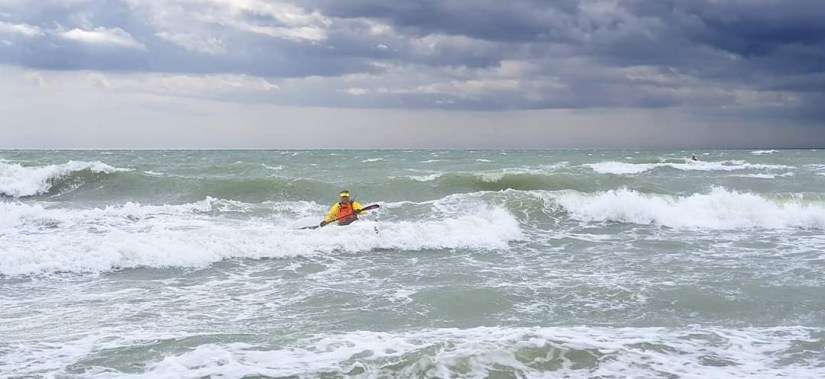
I often ask the person who tests skis to do a reentry in the faster boat. Their paddle technique may be just as good in the faster boat, even handling the waves, still rotating just as well – so it may be time for the next step in the surfski career. Many handle paddling great in the faster ski, but not necessarily the reentry. Tired, stressed, breaking waves.
Its possible to overcome. It’s the moment when your butt is turned down into the seat, with both legs out to the same side, before you gripped the paddle and started paddling – that stability is most severely tested during reentry. If you cannot do a reentry in the conditions, you’re in the wrong ski. Maybe you just need to focus training on reentry. My limit (for shoulder-ach) is 60 deepwater reentries in one session, optimally combined with 1-4 min intervalls. Focus on your own achilles in the reentry-process and repeat, repeat, repeat.
Developing Stability – Factors
Those who buy a faster ski early on, often say they were advised to challenge themselves. I think it often was an inner voice telling them to buy the faster and sexier ski. Well, it’s sometimes good. If you never go to the limit, or past – you’ll never know your limits. Stability is developed in paddling, and if you get out paddling more often in the faster boat, you may eventually gain the required stability – if the leap is not too big. It’s of course a risk that the leap is too big, and the surfskier may end up as a golfer instead.
So – if you can’t rotate and legdrive in the conditions you paddle – your surfski development will turn negative. I think it’s difficult to completely avoid when you want to develop as a surfskier, moving up the fast-ski-ladder, trying to beat a friend or two in the next race. It especially happens to people who stick with having just one ski at the time, selling off the stable ski, not being able to transit gradually.
So what is the important factors in developing stability?
- Paddle technique.
- Paddle technique.
- Paddle technique.
- A little balance.
- The sitting position.
– To have (or develop) the necessary body-mobility and core strength to sit straight and ergonomically in the ski, paddling.
– Also to maximize the bodys motion-range during paddling and when shifting weightdistribution in the ski. - To relax.
– Teaching the glutes, the back, the hips to deal with instability.
– Letting those muscles get used to sitting properly in the ski for hours, and to react instantly.
The paddling technique
– keep legdrive and rotation no matter what…..
Paddle Technique provides both speed and stability. As a surfski athlete, or beginner, you’re often faced with the fact that – ”if I just keep paddling pretty hard right now, I’ll go over the crest, and straighten up myself and the ski in the next paddle stroke, and get that smooth run”. This situation instead often ends up with too much brace, and a missed wave. The positive thing is that a new wave is coming from behind. But that friend may be one or two waves ahead already….. One way to practice this, is to sit in the front of an S2, where you can trust the friend behind to stabilize the team -you just keep paddling, no matter. It may also be an exercise in trusting other people 🙂
Then an exercise in trusting your own paddling.
Balance
Yes, those with a better sense of balance often develop stability more quickly. But this has surprisingly little effect. For example, I see friends with noticeably great problems standing on one foot when the neoprene gets on and off – but no problems in a fast, tippy ski in rough seas. No – it depends more on other things.
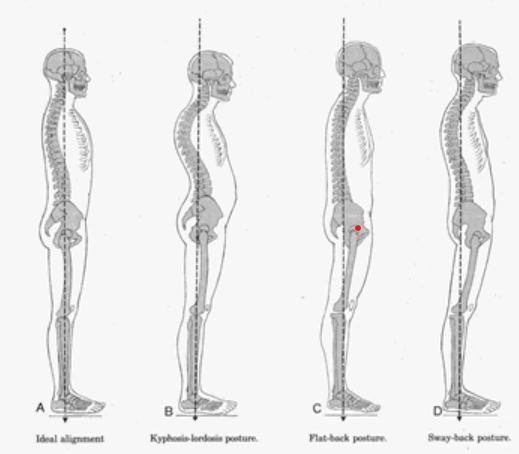
Well, yes, A is the one to strive for in ”all sports” and in life. The upper body should be like A, even if we sit down in the cockpit, bending hips and knees.
Posture – Sitting position
Many people need to straighten their back, for the spine to bend in the natural S-shape – often called ”athletic basic position”. The athletic basic position is difficult, because the hip needs to bend when we sit down in the ski, but with this slight adjustment, the athletic basic position should be pursued for the upper body. The arch in the back and the upright, proud posture provides the best conditions for a stable, forward-driving, paddling technique, as this position gives the core and pelvis the best position to respond to waves and instability, as well as the best mobilityrange for rotation and speed. The athletic basic position in the ski requires musclemobility, and also strong muscles by the lower pelvis.
It’s obvious that many surfskiers would be faster and more stable with better mobility and (lower)core strength. Middle-aged men in particular, often show the sub-optimal combination of rather strong visible gym-muscles, rigid/tense inner-body-muscles (often invisible muscles), insufficient lower-core strength and mobility, and the attitude that real men don’t do yoga. It’s a shame because yoga or such, is the form of exercise that would give the greatest speed and stability improvement per hour invested – for those guys.
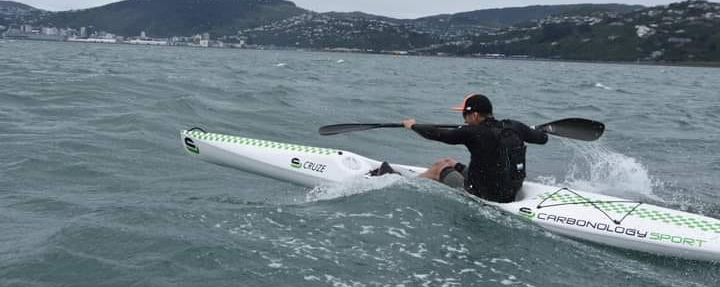
Also a position with lots of potential for even better speed and stability…….
1. Get the butt furter back in the seat, by pushing the heels.
2. Straighten up the upperbody, and bend the lover back forward to ”the atletic basic position”.
3. Breathe. Relax
4. Keep paddling – Enjoy
Relax – Find the right stress level
By relaxing, more muscles, also the smaller but important ones, and the nerve system, especially in the core region, can be activated better. Muscles or muscle-groups previously not activated can be found by the nervous system. You may also get more use from muscles previously tense like violin strings. A relaxed and focused nervous system lets the muscles use their full length of mobility. A more active body, with more aktive muscles, parries the waves. This does not work when the body is at full tension in a tippy ski.
No, it’s not about deep relaxation or sleep – the heart rate may be very high and the level of consciousness at an absolute peak – it’s about not tensing up, but still use relaxed muscles (and mind) on top of their performance, full operation range, not limited.
Develop stability – Tips and tricks
Yes, you probably already figured it out – stability in surfskis is all about paddling technique. I still want to share things that worked for me and for others. This is tips I got from others, mentors in our Swedish surfski community or from surfski-celebs online. As usual, this is more of ”proven experience” than science.
Challenge yourself
For some – that yoga-session is too much of a challenge for the masculine self-identity, so….
Yes – a faster ski or building up the seat, for example with layers of sleeping pads or the like, may be fun and rewarding. Or buy an old, vintage, budget K1. Borrow a friend’s ski or K1. Joining a club with boats in most segments is still the best tip ever.
By paddling a faster boat, you may get a feeling for what does not work, for example sitting with your paddle in the air while waiting for your friend – find out that you need to brace also at 0 km/h. The realization that end-stability is important on the crest of the wave, and that this also can be adjusted with the paddle. Bad posture and short muscles/mobility impact stability more obviously. Also further understanding that significant more leg/foot-pressure on the footwell than the paddelblade-pressure to the water (or vice -versa) makes the ski wobble from side to side. The understanding that stability is in the paddle rather than in the boat. Paddling a faster ski simply provides valuable insights, valuable also when youre back in the stable boat.
As mentioned, don’t paddle the faster boat with the footrest further away – Absolutely no adjustments of the boat, paddle or any equippment in order to cope. All of this – has for sure – an immediate and negative impact on your paddling technique. Feel free to sit in a tippy boat for a while sometimes, but be aware that you must paddle with unchanged technique, including full legdrive and rotation. If not – wait a few weeks or months until you are ready. Maybe next summer.
Feel free to sit in a somewhat tippy ski that requires 200% focus in order to keep upright, legdrive and rotation, but not a full session – change boats for part of the session, and relax your core-muscles in a stable boat after testing the tippy one. Then get back to the tippy ski right away, in order to transit the relaxed core to the faster ski. Make sure you fully use legdrive and rotation all the time. Don’t run too long sessions in a tippy ski or K1 – high risk to develop worse technique, usually unconsciously.
Paddle a crazy stable boat
This is the trick that will provide the most stability (and speed) – of all those tips and trix out there. Yes, you may experience that such pram is slow, heavy, maybe boring. Take the challenge to keep up with your friends in the usual speed, even flatwater – especially flatwater, by enhancing paddling technique. Focus on rotation, more powerful legdrive, instantly accomapanied with equally higher pressure to the paddleblade – then a higher frequency….. Practice the super-efficient technique in the stable boat. and ”rubb it in”. Finetune your foot pressure in relation to the paddlebladepressure to the water. Practice rotation in the seat “with a champagne glass on the foredeck”. I promise – the technique that gives you the most speed in the wide boat – will also give you increased stability in the faster boat, as long as you’re able to rotate and legdrive fully.
When you paddle an insanely stable ski, your body may relax more than in your normal ski, all of you. This means that you may exercise previously non-activated or tense muscles, located by the hips, lower pelvis and around the spine. Paddle long sessions in the insanely stable boat and practice stability this way. Feel free to challenge stability, such as overrotation-exercises, in flatwater and in waves. Paddle-rotate 360 degrees in the cockpit like Zach & Jerry when surfing 22km/h, but you may start at 0 km/h, flat water. Rotate those 360s in the seat also very slow but controlled, or as fast as possible.
It’s the combination of practicing stability in an very stable ski, your “normal ski” and also challenging yourself in a faster ski, that gives you better stability. This may also improve your posture at the office. In terms of time – spend way more time in the insanely stable than in the faster ski. It gives better and faster results – for sure!
Paddle often, long time
Stability seems to come automatically – the more you paddle, you develop your technique by just paddle the ski. It’s usually explained by the bodys natural adaptation to the activity. The nervous system activating muscles in a better way, a bit like a ”biofeedback”. Use your ski, take a bath, have chat with friends while paddling, do intervals, whatever, everyday, all summer long.
The same applies to stability in waves. Paddle a lot in waves, and stability in waves gets better, almost automatically. If you only paddle flat water, stability in waves develops only moderately.
Develop paddling technique
It all comes down to the most fundamental skill for stability – paddle-technique. Practice technique, get yourself filmed, watch YouTube clips from established surfski or K1 coaches. Get the necessary strength and mobility. Take lessons and get an experienced look at your technique.
In summary……
… it’s great fun to strive up ”the faster surfski ladder” it gives you so much back – chasing waves and friends. But the path to the faster ski better be controlled and slow enough, often in a slow boat……
Stability in waves and flat water is very different, and also very much the same. If you can not legdrive and rotate fully, the faster ski is yet slower, and destroys your technique, or also in flat water.
Climbing the faster surfski ladder may be an important factor when racing, chasing friends and waves, or as a route to strive for mental health. If not racing – you may not bother about a faster ski. When racing, or chasing – consider the stable ski as the faster and more fun ski, especially in rough seas.
Paddle technique is the basis of everything in surfski stability. Can you rotate and legdrive fully in those cross-waves?
Make sure your sitting position is the athletic one, and that your core mobility and stremgth enables a good paddling. If not – just sign up to that yoga, pilates, falun gong or ”whatever-class” right away, because it’s gonna give your surfski-stability (and speed) more than any ski or interval-session ever will.
Loads of time in different skis……. More time in the very stable one.
Speed is in the athlete – not the boat.
Stability eats speed – for breakfast……
See you at the surfski-beach!
Cheers,
//Örjan Skatt
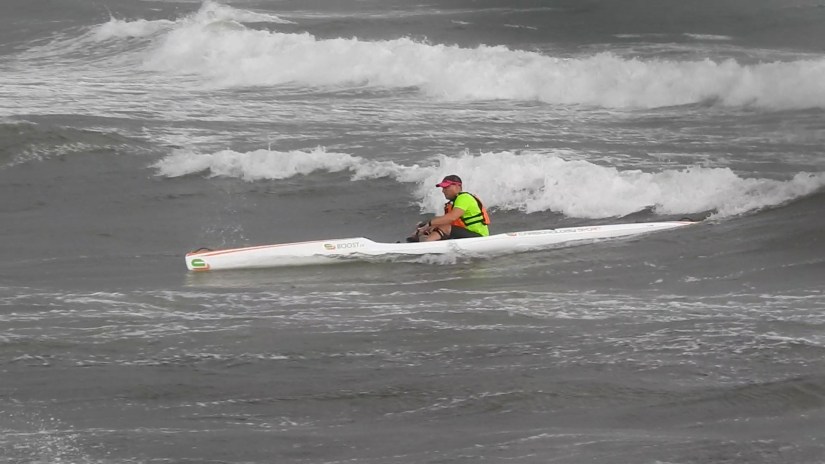
Stable ski – Out & In – Safe Beach – 22 m/s – 22 Degrees C.
Varberg, Apelviken, Swedish Westcoast

 Örjans Skidskola